
Cheapest Ways to Buy PC Games in 2026
A new AAA release listed at $69.99 on Steam typically costs $45–55 through third-party marketplaces, and older titles drop to $15–25. The gap between wha...
A new AAA release listed at $69.99 on Steam typically costs $45–55 through third-party marketplaces, and older titles drop to $15–25. The gap between what a game is listed at and what you can actually pay for it is wider than most players realise, but it comes with a trade-off between price, risk, and how long you're willing to wait.
This guide covers the five cheapest routes, when the major sales actually fall in 2026, how the savings compare against the risk each route carries, and how to check a reseller before you pay.
Disclosure: Cdkeycompares is a free price comparison service and earns commission when readers click through to merchants. We don't sell keys ourselves.
How PC Game Pricing Actually Works
Before comparing where to buy, it helps to know why the same key carries several different prices at once. Because that's what every method below is exploiting.
Publishers set prices by region and by product tier, not as a single global figure. A title priced at $69.99 in North America may be a fraction of that in Latin America or Eastern Europe, because publishers price to local purchasing power. Bulk allocations, bundle leftovers, and promotional stock add further tiers below retail.
Third-party marketplaces exist in the gaps between those tiers. That's why the same key can be listed at $69.99 and $45 simultaneously, not because one is fake, but because they entered the market at different prices. Our guide to what grey market keys are explains the sourcing behind that in detail, and why key prices are so low covers the short version.
Understanding that structure matters for a practical reason: some price gaps are structural and safe, and some exist because someone is absorbing a loss. The methods below are ordered with that distinction in mind.
5 Cheapest Ways to Buy PC Games in 2026
There are multiple ways to buy PC games right now at low prices. Let’s explore them:
1. Official Storefront Sales
The most reliable savings available, with no risk attached. Steam, Epic Games Store, and GOG all run seasonal sales with discounts across most of the catalogue.
The catch has always been waiting. Here is the confirmed 2026 calendar so you can plan around it:
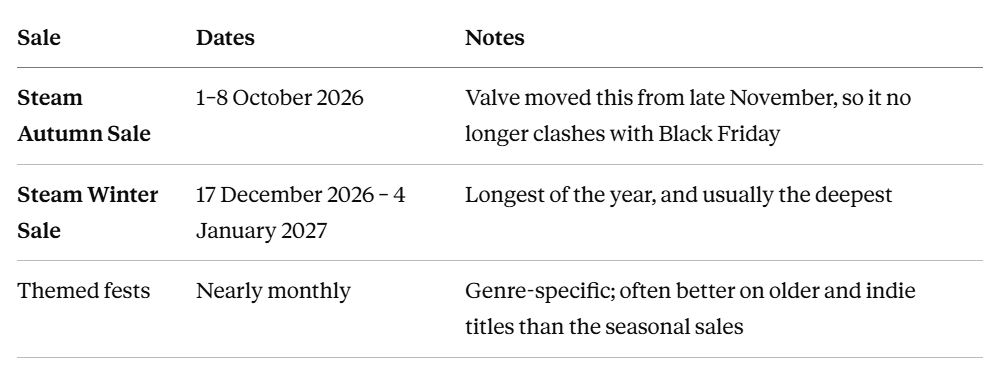
Dates come from Valve's published Steamworks schedule; SteamDB tracks them alongside price history.
The myth worth killing: waiting until the last day of a Steam sale gains you nothing. Valve retired flash deals and daily deals back in 2015. The discount you see on day one applies to the whole event. Buy when you see it.
The check that actually matters: a sale price isn't automatically a good price. Discounts can repeat, and a title at 50% off may have been 75% off in a previous event. Check the historical low on SteamDB or IsThereAnyDeal before deciding a sale price is the floor.
2. Authorized Price Comparison Sites
Sales require waiting for a date. Comparison sites don't. They show you what every seller is charging for a title right now, in one view.
This is the most practical route to a cheap, legitimate key outside a sale window, because the price spread between merchants for the same key is frequently larger than a seasonal discount. It also surfaces the outliers: a listing far below every other seller is information about sourcing, not a bargain the market missed.
Compare current prices across our listed merchants, with fees and stock levels accounted for rather than headline prices alone.
3. Bundle services
Humble Bundle and Fanatical sell curated bundles at a fraction of the combined retail price, and Humble directs a portion of proceeds to charity — a genuine consideration for some buyers.
The honest caveat: bundles are excellent value only if you want several of the games in them. The per-title cost looks remarkable and the cost of the games you'd actually have bought often isn't much lower than buying them individually. Judge a bundle on the two or three titles you genuinely want, not on the headline count.
4. Subscription services
Game Pass–style subscriptions give access to large libraries for a monthly fee, which works well if you play broadly and don't need to own anything permanently.
The trade-off is ownership. Titles rotate out, and access ends with the subscription. For a backlog player who finishes a game and moves on, that's irrelevant. For anyone who replays or wants a library that stays put, a subscription is renting rather than buying — and over several years the cost usually exceeds buying the handful of games you'd actually keep.
5. Grey market marketplaces
Third-party marketplaces like Kinguin, G2A, and K4G list keys from independent sellers at substantial discounts. The savings are real and so is the variance.
These sellers don't source from publishers directly. Most keys come from regional pricing differences or bulk and promotional stock, both of which are structurally cheap and generally safe. A minority come from press allocations resold after their access window, or from fraudulent purchases and those are the keys publishers revoke. Our G2A vs Kinguin vs Eneba comparison covers how each platform handles disputes when a key fails.
This route belongs last on the list deliberately. It offers the largest discounts and demands the most checking, which the framework below sets out.
Comparison Between Sellers: Savings vs Risk vs Convenience
Each method trades off differently across three things: how much you save, how likely something goes wrong, and how much effort or waiting it takes.
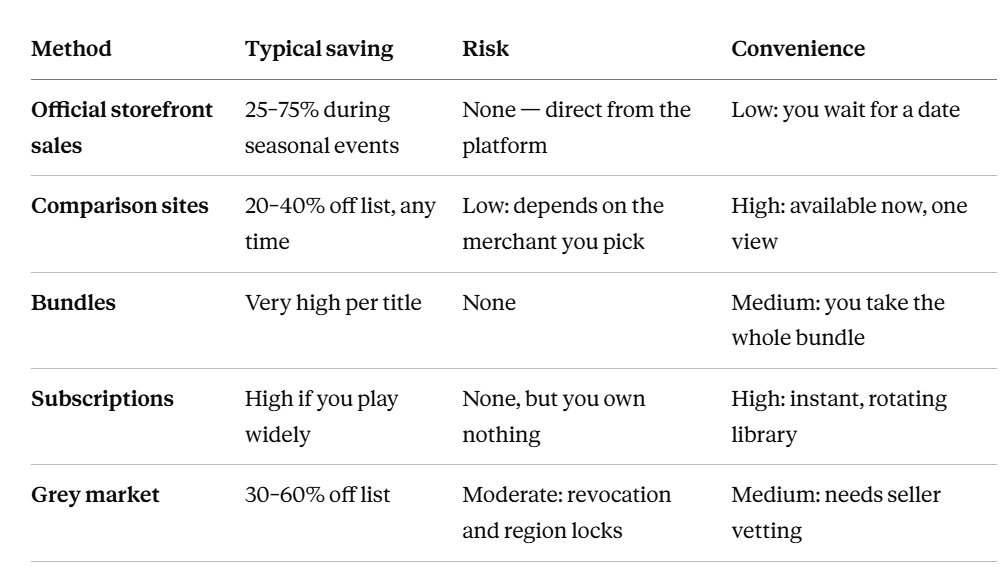
How to read this table: the biggest discount and the lowest risk are never in the same row. If you want maximum saving with zero risk, wait for a seasonal sale. If you want a low price today, a comparison site gets you most of the way with far less checking than a marketplace. The Grey market's extra discount over a comparison site is smaller than most people assume once you price in the occasional dead key.
Are Cheap Game Keys Safe? A Risk-Level Framework
Risk in this market isn't evenly spread. It concentrates in identifiable places, which means a few minutes of checking removes most of it. Here's how to place any listing you're looking at.
Low risk - official storefronts and comparison-listed merchants: Steam, Epic, GOG, and established merchants with public track records. Prices are higher than the deepest marketplace listings, but revocation and account issues are effectively off the table.
Medium risk - reputable marketplace sellers: Sellers with 90%+ positive ratings and active buyer protection. Prices beat official channels meaningfully. The remaining risks are region-locked keys that may not work in your area. Another risk is revocation if the seller got the key improperly. Buyers cannot know this at purchase.
High risk - thin or anonymous sellers: These sellers often have Incomplete profiles, few or no reviews, and a new AAA release priced far below every other listing. That last signal is the clearest single predictor of a bad outcome. A price nobody else can match usually means sourcing the seller would rather not explain.
For the fuller treatment, see our guide on whether CD keys are legit.
Is it Legal to Buy Grey Market Game Keys?
For the buyer, purchasing a grey market key is generally not a criminal act in most jurisdictions. The keys are genuine, publisher-issued codes resold outside authorised distribution. They are not counterfeit or pirated goods.
Two qualifications matter:
It may breach a platform's terms of service: Steam, Xbox, and PlayStation each reserve the right to revoke keys and restrict accounts where they identify regional manipulation or fraudulent sourcing. That's a contractual matter rather than a criminal one, but the practical consequence- losing a game or, rarely, an account— is real. The Steam Subscriber Agreement sets out Valve's position directly.
The legal position varies by region: European law recognises a principle of exhaustion permitting resale of some digital licences, though how far it extends to game keys specifically remains contested. Treat this as general information rather than legal advice, and see Are cheap game keys legal for the detail.
In practice, platforms rarely act against ordinary buyers. Enforcement clusters around bulk regional manipulation and traceable fraud, not individual purchases.
How to Buy Safely from a Reseller
Knowing where the risk sits is one thing; here's the sequence that removes most of it. It takes about five minutes.
Before you buy:
Check the seller's rating and profile depth: Look for 90%+ positive feedback and a substantial review history, not a handful of recent five-star ratings. Independent sources like Trustpilot tell you more than on-site testimonials. Our merchant profiles collect review scores, delivery speed, and support quality for every store we list.
Confirm the region: The key should match your account's region or be listed as Global. This single check eliminates the most common failure mode. See region-locked game keys if you're unsure what applies to you.
Require a written replacement or refund policy: Not a vague promise of support. Merchants confident in their sourcing publish one.
Compare the price against other listings: If it's far below everything else, that's a signal rather than a saving.
Pay with a credit card or a protected payment service: Chargeback rights are what determine whether a bad outcome costs you money or just time.
After you buy:
Redeem immediately and verify activation: Don't sit on a key. Revocation risk is highest before redemption, and most refund windows are short.
Keep the invoice and order confirmation: Both are required if you later need to dispute a revoked key and are much harder to reconstruct after the fact.
If a key has already failed, our key doesn't work page walks through recovery in order.
FAQs
1. What's the difference between an Authorised Key seller and a Grey Market reseller?
An authorised seller sources keys directly from publishers or appointed distributors, so revocation risk is effectively nil. A grey market reseller is a marketplace. Independent sellers list keys there. The keys come from many sources. Most sources are legitimate. Some are not. The keys are genuine in both cases; what differs is how much you know about where they came from.
2. How do I get free PC games legally?
The Epic Games Store gives away titles weekly, Amazon Prime Gaming includes a monthly selection with a Prime subscription, and publishers run periodic giveaways. All are legitimate, permanent additions to your library with no account risk.
3. Are Grey Market keys safe to use?
Usually, but not always. The key itself is genuine, and most are sourced through regional pricing or bulk purchasing, both benign. The risk is revocation where a seller sourced a key fraudulently, which a buyer can't detect at purchase. Buying from a highly rated seller with buyer protection reduces it substantially without eliminating it.
4. What should I do if a purchased key gets revoked?
Contact the seller first with your order documentation and cite their replacement policy. Reputable merchants resolve this routinely. If they're unresponsive, escalate to the marketplace's buyer protection, then open a dispute with your payment provider. This is why keeping the invoice matters.
5. When is the next Steam sale in 2026?
The Steam Autumn Sale runs 1–8 October 2026, and the Winter Sale runs 17 December 2026 to 4 January 2027. Themed genre fests run nearly monthly in between and often discount older and indie titles more deeply than the seasonal sales do.
6. Do prices drop further at the end of a Steam sale?
No. Valve retired flash and daily deals in 2015, so the discount shown on day one holds for the entire event. There's no advantage to waiting, and you risk forgetting.
Final thoughts
The cheapest route depends on what you're buying and how patient you are. For a specific new release you want soon, compare merchant prices; the spread between sellers usually beats waiting. For a backlog you're in no hurry to clear, seasonal sales and bundles give the deepest discounts at no risk. For broad, exploratory play, a subscription costs less than buying the same breadth outright.
Whichever route you take, the three checks that decide your outcome are the same: confirm the key's region, check the seller's track record independently, and pay with a method that carries chargeback rights.