
Are Cheap Game Keys Legal? Full Guide 2026
A cheap game key is not automatically legal or illegal simply because of its price. Its legal status depends on where the key came from, how it was obtained,...
A cheap game key is not automatically legal or illegal simply because of its price. Its legal status depends on where the key came from, how it was obtained, which country's laws apply, the publisher's distribution agreements, and whether the sale complies with applicable licensing and consumer laws. A cheap key isn’t a risk for anyone unless they are stolen or fraudulently used, and it can make your game account permanently banned, even if you did nothing unlawful.
This guide explains the legality of cheap game keys, when it becomes questionable, and the difference between illegal game keys vs unauthorized resold game keys. It also covers differences between sellers, whether a cheap game key can ban your account, and how to reduce legal and financial risks before the purchase.
Are Cheap Game Keys Legal?
A cheap game key can be legal, but it depends on how the key was originally obtained and sold. Buying a discounted game key from an authorized retailer is generally lawful, while a key obtained through fraud, theft, or unauthorized distribution may create legal, contractual, or consumer protection issues. However, the price alone does not determine legality.
A publisher may intentionally sell a game at different prices across different countries, through authorized partners, or during seasonal promotions. Those keys remain legitimate because they entered the market through approved distribution channels.
On the other hand, some cheap CD Keys available on third-party marketplaces may originate from unauthorized sources. In those situations, the legal questions become more complicated because different legal frameworks apply, such as:
Copyright law: It asks whether copyrighted works were unlawfully distributed.
Contract law: It focuses on agreements between publishers, distributors, and sellers.
Terms and Conditions: Platform terms, such as the Steam Subscriber Agreement or publisher terms, govern how activation keys may be used.
Consumer Protection Laws: They determine what rights buyers have if something goes wrong.
Understanding if the cheap game keys are legal or not, continue reading.
Why Are Game Keys So Much Cheaper?
The existence of cheap game keys does not automatically indicate fraud. There are several legitimate business reasons why prices vary across the digital distribution ecosystem.
Regional Pricing
Many publishers adjust prices to match local purchasing power. For example, a game may launch at one price in North America and a much lower price in another country. This pricing strategy helps publishers reach customers in different markets.
Cause and effect
Lower regional pricing creates opportunities for price arbitrage, where someone purchases keys in a lower-priced market and attempts to resell them elsewhere. While the original key may be genuine, cross-region resale can conflict with publisher distribution agreements or regional licensing policies. This is one reason some publishers introduce region-locked game keys.
Authorized Retailer Promotions
Not every retailer sells games at the same price. Publisher-authorized partners such as Humble Bundle, Fanatical, Green Man Gaming, and Gamesplanet regularly negotiate promotional pricing directly with publishers. These discounts often happen because:
marketing campaigns are scheduled
publishers want greater exposure
publishers aim to increase sales volume
seasonal sales encourage purchases
These game keys remain legitimate because they were supplied through approved distribution channels.
Bundle Sales
Publishers frequently include games in charity bundles, franchise collections, or promotional packages. Some buyers only want one title and resell unused activation keys where permitted by applicable agreements. Whether that resale complies with local law or contractual restrictions depends on the specific circumstances and jurisdiction.
Promotional and Review Keys
Publishers also distribute:
promotional keys
influencer keys
review copies
press access keys
These are intended for specific recipients rather than public resale. If such keys are resold without authorization, the issue may involve contractual restrictions rather than copyright infringement. That distinction matters because violating a publisher agreement is not necessarily the same legal issue as distributing stolen software.
Wholesale Purchasing
Large retailers sometimes purchase significant quantities of activation keys at wholesale prices. Lower acquisition costs allow them to offer competitive discounts while remaining profitable. It means the retailer is authorized by the publisher; lower pricing alone does not make those keys suspicious.
Marketplace Competition
Third-party marketplaces allow multiple sellers to compete on price, and it naturally drives prices down. Unlike authorized retailers, some marketplaces primarily facilitate transactions between independent sellers. Even the marketplace itself may not be the original source of every game key. That is why seller verification, buyer protection, and reseller transparency become important considerations.
When Is a Cheap Game Key Completely Legal?
A cheap game key is generally considered the lowest-risk purchase when it originates from a lawful distribution chain approved by the publisher or rights holder. Several common situations make a cheap game key legal:
The Key Comes from an Authorized Retailer
The safest scenario is purchasing from a retailer that has a direct commercial relationship with the publisher. These retailers receive activation keys through official publisher distribution agreements rather than independent third-party sourcing. Because the publisher intentionally supplied those keys, there is typically little legal uncertainty regarding their origin.
The Publisher Is Running a Legitimate Promotion
Publishers frequently discount games during these situations:
seasonal sales
anniversary events
franchise promotions
publisher weekends
launch campaigns
The game key remains legitimate because the publisher approved the promotion. The discount affects the price, not the license legitimacy.
The Retailer Obtained Keys Through Approved Distribution
Some authorized retailers purchase keys in bulk from publishers or licensed distributors. Bulk purchasing reduces costs and enables lower prices without involving unauthorized resellers. This is similar to how traditional retailers negotiate wholesale pricing for physical products.
The Key Is a Genuine Digital License
One important misconception is that buyers "own" the software. In reality, purchasing a game key generally grants a digital game license, not ownership of the underlying intellectual property.
Cause and effect
Because buyers receive a license rather than ownership of the game itself, the license remains subject to the publisher's End User License Agreement (EULA), platform terms, and applicable law. This explains why publishers may impose activation requirements, regional restrictions, or account-related conditions even after purchase.
Understanding this distinction helps explain why some disputes involve licensing agreements rather than copyright law.
The Sale Complies with Applicable Laws
Different countries treat software licensing and digital resale differently. Some jurisdictions recognize broader resale rights for certain digital goods, while others place greater emphasis on licensing agreements.
Note: Jurisdiction-specific rules regarding digital software resale continue to evolve and should be reviewed according to the applicable country's laws.
For buyers, this means a key that is legally sold in one jurisdiction may involve different legal considerations elsewhere.
Not Every Cheap Price Is a Warning Sign
Low prices can result from:
publisher-approved promotions
wholesale purchasing
regional pricing strategies
legitimate competition
bundle discounts
None of these automatically indicate illegal activity. Instead of asking whether a key is "too cheap," a better question is: Can the seller clearly explain where the game key came from? The answer to that question often provides more useful insight than the price itself.
When Does a Cheap Game Key Become Legally Questionable?
A cheap game key becomes legally questionable when there is uncertainty about how it entered the market. Legal concerns arise when the key's source, method of acquisition, or resale may conflict with copyright law, contractual agreements, consumer protection laws, or publisher policies.
Not every questionable key is illegal and not every unauthorized resale violates copyright law. Understanding these distinctions helps buyers evaluate risk more accurately.
The Key's Origin Cannot Be Verified
One of the biggest warning signs is a lack of transparency. If a marketplace or seller cannot explain where a game key originated, buyers have little way to assess whether it came from:
an authorized distributor
a legitimate promotional campaign
a wholesale purchase
an individual resale
an unauthorized source
Unknown sourcing does not automatically make a key illegal, but it significantly increases uncertainty. However, a transparent seller should be able to describe its sourcing practices without relying on vague statements such as "100% genuine" or "lowest prices guaranteed."
The Key Was Obtained Through Fraud
A game key may become problematic if it was originally purchased using fraudulent payment methods. These are:
stolen credit cards
compromised payment accounts
unauthorized transactions
payment fraud
Cause and effect
When the legitimate cardholder disputes the payment, a chargeback may reverse the original transaction. Because the publisher or authorized retailer no longer receives payment, the associated activation key may later be revoked. In this case, the buyer may lose access to the game even if they purchased the key in good faith from another seller.
The buyer is not necessarily responsible for the original fraud, but they may still experience the consequences if the publisher invalidates the key.
The Key Violates Distribution Agreements
Publishers often authorize distributors to sell game keys only within specific territories or sales channels. If those keys are later resold outside the agreed distribution network, the issue typically involves contractual obligations between businesses, such as:
a distributor may have agreed to sell only within one region
promotional keys may have been restricted to reviewers
wholesale inventory may have been intended for a particular retailer
The resale is not automatically copyright infringement, but it may violate contractual agreements established by the publisher. This is one reason publishers monitor unauthorized distribution channels.
The Seller Circumvents Regional Restrictions
Some marketplaces advertise game keys intended for other countries. These listings may encourage buyers to:
activate through another region
temporarily change their account location
use a VPN during activation
Cause and effect
Regional pricing exists because publishers intentionally set different prices for different markets. Circumventing those restrictions can undermine that pricing strategy and may violate platform or publisher terms, even if the underlying game key is genuine. The legal consequences vary by jurisdiction, and enforcement differs among publishers and platforms.
Note: The treatment of cross-region activation and VPN-assisted activation differs across platforms and applicable national laws.
The Marketplace Provides Little Buyer Protection
Legal uncertainty is not the only concern. Some marketplaces operate primarily as platforms connecting independent sellers with buyers. In those cases, the marketplace may not verify every seller's inventory before listing products. If a problem occurs, buyers may encounter:
delayed refunds
disputes over key validity
limited customer support
difficulty proving how the key was sourced
This does not make the marketplace unlawful, but it increases the practical risk associated with the purchase.
Illegal Game Keys vs Unauthorized Resold Game Keys
These two terms are often used interchangeably, but they describe different situations. Confusing them leads to many misconceptions about game keys.
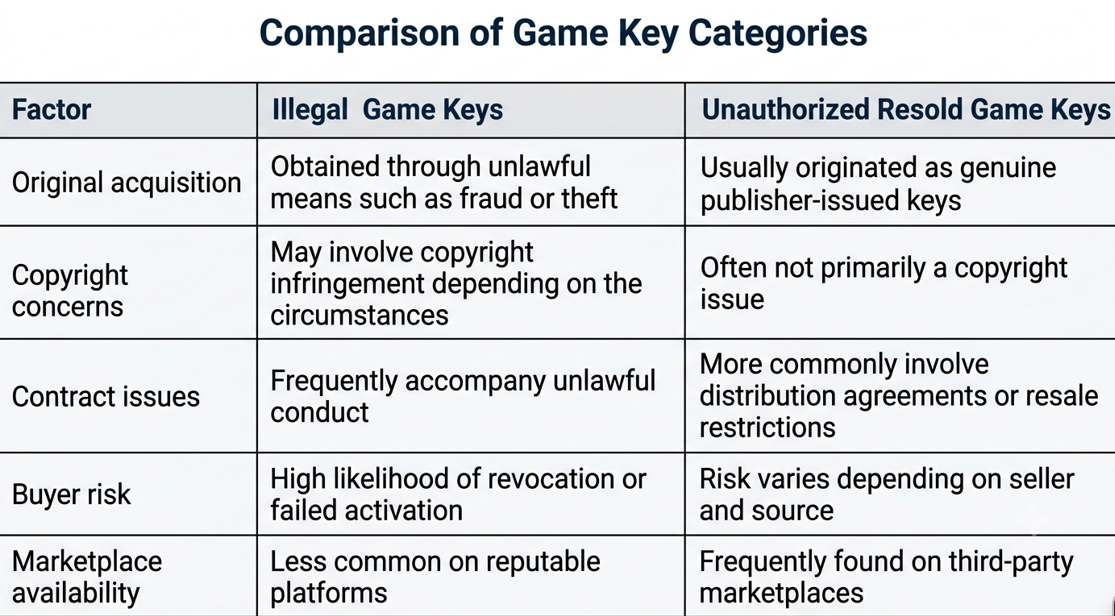
The distinction matters because different legal principles apply. Read our guide on CD keys vs. Official Stores before the purchase.
What Makes a Game Key Illegal?
A game key may be considered illegal if it originates from this situation, such as:
payment fraud
stolen financial information
unauthorized system access
counterfeit key generation
other unlawful acquisition methods
The legal issue arises from how the key was obtained, not from the fact that someone later sold it at a discount. For buyers, determining the source is often impossible, which is why reputable sourcing matters.
What Is an Unauthorized Resold Game Key?
An unauthorized resold game key is typically a real activation key that entered the market legitimately but was later sold outside the publisher's approved distribution network.
Examples might include:
promotional keys resold without permission
bundle keys resold individually
region-specific inventory sold internationally
excess inventory purchased from intermediaries
Whether these sales are lawful depends on several factors, including:
applicable national law
contractual obligations
publisher policies
marketplace rules
Because these variables differ, unauthorized resale should not automatically be described as illegal.
Why This Difference Matters for Buyers
Many buyers assume that if a game activates successfully, the transaction must have been legitimate. Activation alone does not reveal how the key entered the marketplace. Likewise, a revoked key does not necessarily prove that the buyer committed wrongdoing.
Understanding the difference helps buyers evaluate both legal risk and practical risk, which are not always the same.
How Do Publishers, Marketplaces, and Copyright Law Differ?
One reason this topic is confusing is that several different systems operate simultaneously. Each answers a different question.
Copyright Law Protects the Game
Copyright law protects the intellectual property contained in the game. It governs issues such as:
unauthorized copying
unlawful distribution
infringement of exclusive rights
Simply purchasing a discounted game key does not automatically create a copyright issue. Instead, copyright concerns usually focus on how software or activation rights were originally distributed.
Contract Law Governs Business Relationships
Publishers, distributors, retailers, and marketplaces frequently operate under commercial contracts. These agreements may specify:
approved territories
resale conditions
pricing policies
distribution rights
If one party violates those agreements, the dispute generally concerns contract law rather than copyright infringement. This distinction is often overlooked in simplified discussions about "legal" and "illegal" keys.
End User License Agreements Govern Buyers
When activating a game, buyers typically agree to an End User License Agreement (EULA) or platform-specific terms, such as the Steam Subscriber Agreement. These agreements may address:
license scope
account usage
regional activation
prohibited conduct
transfer restrictions
Violating a platform's terms does not automatically constitute a criminal offense or copyright infringement. However, it may give the platform contractual grounds to restrict access, suspend features, or revoke licenses where permitted under its terms.
Publishers Set Distribution Policies
Publishers set the distribution policies:
who may sell their games
where games may be sold
which retailers receive activation keys
how promotional campaigns operate
These are commercial decisions rather than legal rulings. A publisher may choose not to recognize a reseller as an authorized partner even if that reseller's conduct is not unlawful under applicable law.
Marketplaces Facilitate Transactions
Many third-party marketplaces do not own their inventory list. Instead, they provide a platform where independent sellers offer game keys. As a result, responsibilities are often divided:
sellers supply the keys
marketplaces establish listing rules
publishers issue and manage activation keys
platforms such as Steam or Epic Games Store handle activation
Understanding these separate roles helps explain why disputes can involve multiple parties.
Why Separating These Issues Leads to Better Decisions
Many online discussions treat every dispute as if it has one simple answer. In reality, buyers should ask several separate questions:
Was the game key obtained lawfully?
Did the seller have authorization to resell it?
Does the sale comply with platform terms?
What protections are available if something goes wrong?
Could the publisher revoke the key under its licensing policies?
Each question addresses a different type of risk. Looking at them individually provides a much clearer understanding than simply labeling every cheap game key as either "legal" or "illegal."
Can Buying a Cheap Game Key Get Your Account Banned?
Simply purchasing a cheap game key does not automatically result in an account ban. However, using a key obtained through fraud, deliberately bypassing regional restrictions, or repeatedly violating platform terms may increase the likelihood of account action, depending on the publisher's policies and the platform involved.
Many discussions exaggerate the risk by claiming that buying from any third-party marketplace will get your Steam or Epic Games account banned. In practice, enforcement is typically based on what happened, how the key was obtained, and which platform's rules apply.
The outcome can range from no action at all to key revocation, license removal, or, in more serious cases, account restrictions.
When Is an Account Action More Likely?
Although policies differ between platforms and publishers, account action depends on the situation. It involves intentional abuse rather than an ordinary discounted purchase. These are the reasons for an account action:
Activating keys known to be obtained through payment fraud.
Repeatedly using VPNs to bypass regional purchasing restrictions.
Exploiting regional pricing on a large scale.
Violating platform-specific terms governing account location or activation.
The platform evaluates the conduct, not simply the price paid.
What It Means by Key Revocation vs Account Ban
These are often confused, but they are very different outcomes.
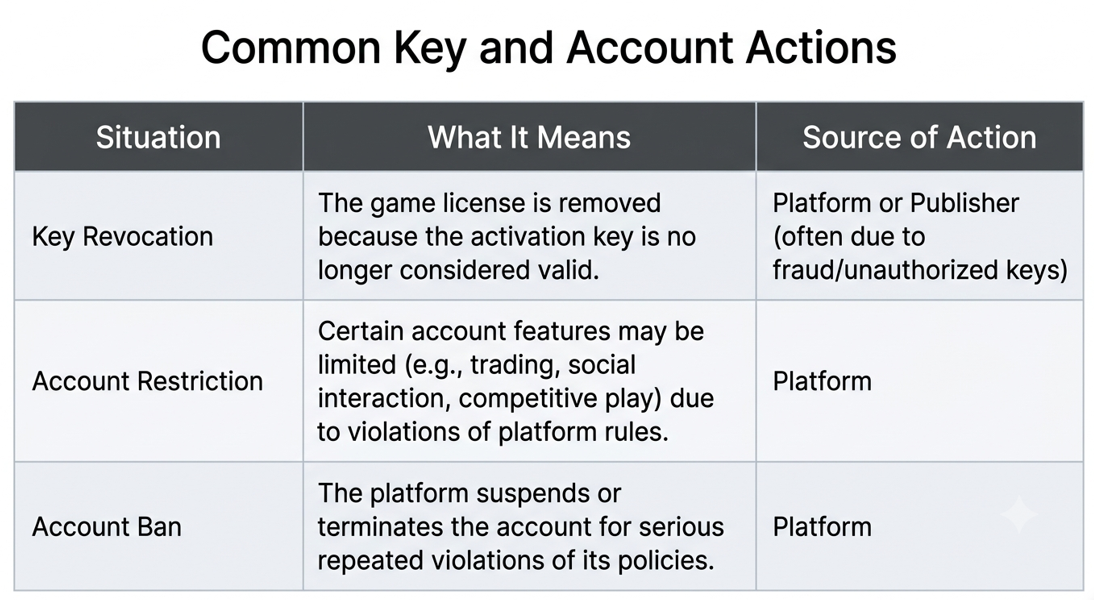
A revoked game key does not automatically mean the account will also be banned. In many reported cases, publishers simply invalidate the affected license while leaving the user's account otherwise unaffected.
Why Publishers Revoke Some Keys
Publishers revoke keys for several reasons, including:
confirmed payment fraud
chargeback disputes
stolen promotional keys
unauthorized distribution
accidental key leaks
Cause and effect:
If an authorized retailer loses payment because of a chargeback, the publisher may invalidate the associated activation keys to reduce financial losses. The buyer who later purchased that key from another source may lose access to the game despite having no involvement in the original fraud.
This demonstrates why understanding the source of a game key matters more than focusing solely on its price.
Platform Policies Matter
Different platforms enforce their own rules. For example, platforms may address issues such as:
account location
regional purchasing
license transfers
fraudulent activity
marketplace abuse
Because these rules evolve, buyers should review the current terms published by the platform they intend to use.
Note: Platform enforcement policies may change over time and should be confirmed using the latest platform documentation.
How to Reduce Legal and Financial Risks Before Buying
No purchase is entirely risk-free, but buyers can significantly reduce both legal uncertainty and financial risk with the following:
Prefer Authorized Retailers
The simplest way to minimize uncertainty is to buy from publisher-authorized retailers. These sellers receive their game keys directly via approved distribution agreements, reducing questions about the key's origin. Publisher-authorized partners often include stores such as Humble Bundle, Fanatical, Green Man Gaming, and Gamesplanet, depending on the publisher and region.
Research the Seller's Reputation
If purchasing from a third-party marketplace, investigate the seller rather than relying solely on the marketplace's overall reputation. Look for indicators such as:
seller history
verification status
customer reviews
refund experience
transparency regarding key sourcing
A marketplace with thousands of sellers can contain both trustworthy and unreliable vendors. So, learning about “Are CD keys legit” helps you totally understand this situation.
Understand Where the Key Comes From?
Before purchasing, understand where the key comes from to avoid getting illegal keys or wasting money. Ask these questions before the purchase:
Is the key sourced from an authorized distributor?
Is it a promotional or bundle key?
Is it intended for my region?
Does the listing explain its origin?
Greater transparency generally reduces uncertainty and keeps you safe after the purchase.
Verify Regional Compatibility
Some keys are intended for specific countries or regions. Before purchasing, confirm:
activation region
supported countries
platform compatibility
language restrictions, if applicable
Buying the wrong regional version may prevent successful activation even when the key itself is genuine. Therefore, learn about region-locked game keys before the purchase to get the correct license key.
Read the Refund Policy
Refund policies vary between marketplaces. Before completing a purchase, understand these:
when refunds are available
how activation problems are handled
whether evidence is required
expected response times
Strong buyer protection can make a significant difference if a problem arises. However, without buyer protection, you may lose access to the key and won’t get any refund at all.
Be Skeptical of Unrealistic Discounts
An unusually low price does not prove fraud. However, extreme discounts without a reasonable explanation aren’t considered safe. Consider whether the price could reasonably result from:
a seasonal promotion
wholesale purchasing
a bundle sale
publisher-approved discounts
If there is no reasonable explanation behind it, be careful of those discounts.
Avoid Circumventing Platform Rules
Some listings recommend changing your account region or using a VPN to activate a game. Even if the game key is genuine, deliberately bypassing platform restrictions may conflict with platform terms. Following official activation procedures generally reduces any practical risk.
Common Myths About Cheap Game Keys
Misinformation is widespread because discussions often combine legal issues, platform policies, and personal opinions. Let’s explore some of the most common misconceptions.
Myth 1: Every Cheap Game Key Is Illegal
Reality:
Price alone does not determine legality. Many inexpensive game keys originate from:
publisher-approved promotions
authorized retailers
bundle sales
wholesale discounts
regional pricing strategies
The key's source matters more than its cost. So, ensure the seller’s reviews, ratings, and transaction records before making a purchase.
Myth 2: Every Grey Market Key Is Stolen
Reality:
Grey market simply describes sales occurring outside an official authorized distribution channel. Some grey market keys may originate from legitimate purchases, while others may involve questionable sourcing. The license key does not identify how every key was obtained. Read our guide on “What Are Grey Market Keys and Are They Safe in 2026” to realize this market.
Myth 3: Buying a Cheap Key Is Copyright Infringement
Reality:
Copyright infringement concerns unauthorized copying or distribution of protected works. Purchasing a discounted activation key does not automatically constitute copyright infringement. Depending on the circumstances, the relevant issues may instead involve licensing agreements, contractual obligations, or publisher distribution policies.
Myth 4: If the Key Activates Successfully, It Must Be Legitimate
Reality:
Activation confirms that the key was accepted at that moment. It does not reveal the whole scenario:
how the key was obtained
whether payment was legitimate
whether the publisher may later revoke it
Activation is one indicator that the key is legitimate, but it doesn’t ensure a valid sourcing.
Myth 5: Authorized Stores Never Offer Big Discounts
Reality:
Publisher-authorized retailers frequently participate in various sales events, such as:
seasonal sales
publisher promotions
franchise events
bundle campaigns
Significant discounts can be completely legitimate when supplied through approved channels. Therefore, authorized stores offer big discounts, but they won’t offer unusually low prices.
Final Verdict
So, are cheap game keys legal? The most accurate answer is sometimes, and it depends on the source, not the price. A low-priced game key sold by an authorized retailer during a legitimate promotion is generally the lowest-risk scenario.
A key sold through an unauthorized reseller is more complex. It may be genuine, but the sale happens outside the publisher's approved distribution network or involves restrictions. That does not automatically make the transaction illegal, but it may increase practical risks such as limited refunds or future key revocation.
A key obtained through fraud, theft, or other unlawful means may increase a higher level of legal and consumer risk. In those cases, publishers may invalidate the key, and buyers could lose access to the game even if they were unaware of the original misconduct. Therefore, understanding differences between keys might lead you a better purchasing decisions.
Disclaimer: This guide provides general educational information and should not be considered legal advice. Laws governing digital licensing, software resale, and consumer rights vary by jurisdiction. If you need legal advice regarding a specific dispute or country, consult a qualified legal professional.
FAQs
Q1: Are cheap game keys legal in every country?
Ans: No. The legal treatment of digital game licenses and software resale varies between jurisdictions. In addition to local laws, publisher agreements and platform terms may affect how a game key can be sold or used. Check the applicable laws in your country for jurisdiction-specific rules.
Q2: Can Steam ban my account for using a cheap game key?
Ans: A discounted price alone is unlikely to result in an account ban. However, using keys connected to fraud, repeatedly bypassing regional restrictions, or violating platform terms may increase the likelihood of enforcement, depending on the platform's current policies.
Q3: Why are some game keys much cheaper than official stores?
Ans: Legitimate reasons include regional pricing, publisher promotions, wholesale purchasing, seasonal sales, and bundle offers. Lower prices do not automatically indicate that a game key is illegal or counterfeit.
Q4: What's the difference between an unauthorized reseller and an illegal seller?
Ans: An unauthorized reseller may sell genuine game keys outside the publisher's approved distribution network. An illegal seller typically deals in keys obtained through unlawful means, such as payment fraud or theft.
Q5: How can I reduce the risk when buying a cheap game key?
Ans: Choose publisher-authorized retailers whenever possible, verify regional compatibility, review refund policies, research the seller's reputation, and avoid listings that encourage bypassing platform restrictions or fail to explain where their game keys originate.
Looking for a cheap but legal game keys? Check our Cdkeycompares games category or browse reliable merchants to compare the best deal.