
What Are Grey Market Keys and Are They Safe in 2026?
A Grey market key is a genuine, publisher-issued activation code resold outside the manufacturer's authorised distribution channels . It is not pirated and n...
A Grey market key is a genuine, publisher-issued activation code resold outside the manufacturer's authorised distribution channels. It is not pirated and not counterfeit; it is a real key that took an unofficial route to you. Whether it is safe depends almost entirely on one thing: how the seller obtained it.
That distinction is what this guide is built around. Below you'll find how the Grey market differs from official retail and the Black market, the four ways sellers actually source their keys, which of those carry real revocation risk, and a practical checklist for vetting a merchant before you pay.
What is A Grey Market Key?
A grey market is any distribution channel that sells legitimate goods outside the routes authorized by the manufacturer, usually at lower prices than the manufacturer intended. Applied to games, that means a real key that the publisher generated and that will activate normally, bought and resold by someone the publisher never appointed as a retailer.
The key works. It redeems on Steam, Xbox, or PlayStation like any other, and it will keep working unless the publisher specifically revokes it. That last condition is the whole story: revocation happens when the publisher traces the key back to a source it considers illegitimate, not because the key was "grey."
This is what separates the grey market from piracy. A pirated copy circumvents the licensing system entirely. A grey market key uses that system exactly as designed. It just reached you through a side door.
Difference Between Grey Market vs. Black Market vs. Official Retailer
Understanding which of the three you're buying from is the single most useful thing you can do before spending money, because the risk profiles are not remotely similar.
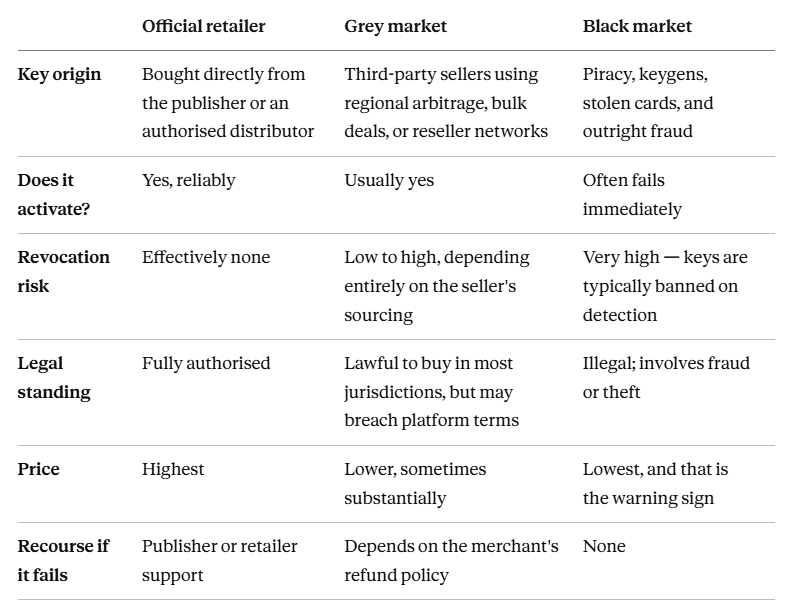
The middle column is where nearly all the confusion lives. "Grey market" describes the channel, not the quality of the key — which is why two keys bought at the same price from two different grey market sellers can have completely different outcomes.
How Do Grey Market Sellers Source Their Keys?
Four routes account for most grey market supply, and they carry very different levels of risk. This is the section worth reading closely, because it explains why some cheap keys are perfectly safe and others die within weeks.
Regional Price Arbitrage
Publishers always price games according to local purchasing power, so the same title can cost far less in some regions than others. Resellers buy where prices are low and sell elsewhere.
The risk: these keys are frequently region-locked and will simply refuse to activate outside their assigned territory. This is the most common reason a legitimately purchased cheap key fails, not fraud, just geography. Always confirm region restrictions before buying; our guide to region-locked game keys covers how to check.
Bulk and promotional purchases
Sellers buy surplus stock, bundle leftovers, or promotional allocations from publishers and distributors, then resell below the standard retail price.
The risk: low. This is the most benign sourcing route and accounts for a large share of genuinely safe discount keys. Bundle-derived keys occasionally carry activation restrictions, but they are rarely revoked.
Press, review, and professional allocations
Some keys are issued to journalists, streamers, or reviewers for time-limited access, then resold rather than used as intended.
The risk: moderate to high. Publishers can disable these once the intended access period ends, and buyers lose the game with little recourse.
Fraudulently obtained keys
Sometimes, Keys bought with stolen credit cards and resold before the fraud is detected.
The risk: severe, and the reason grey market caution exists at all. When the genuine cardholder disputes the charge, the publisher revokes the key. You lose access, and because you were not the fraudulent party but also not the authorised purchaser, refund recovery is difficult.
The pattern to take away: The first two routes produce keys that are cheap for legitimate structural reasons. The last two produce keys that are cheap because someone else is taking the loss. Price alone won’t tell you which you're looking at. Check the seller’s reputation and how they say they sourced the key.
Is Buying a Grey Market CD Key legal?
For the buyer, purchasing a grey market CD key is generally not a criminal act in most jurisdictions. You are buying a genuine product through an unauthorised channel, which is a very different thing from buying stolen or counterfeit goods.
Here are two important qualifications:
It may still breach a platform's terms of service: Steam, Xbox, and PlayStation each reserve the right to revoke keys and restrict accounts where they identify regional manipulation or fraudulent sourcing. Breaching terms of service by purchasing a CD key is a contractual matter between you and the platform, not a criminal one. But the practical consequence, losing access to a game or an account, is real. The relevant terms are worth reading directly: the Steam Subscriber Agreement, the Microsoft Services Agreement covering Xbox, and PlayStation's Terms of Service.
The legal position varies by region and is genuinely unsettled in places: European law has recognised a principle of exhaustion allowing resale of some digital software licences, but how far that extends to game keys specifically remains contested and has been narrowed in later rulings.
If your situation involves significant money or a business account, treat this as general information rather than legal advice and check your local position. For a fuller treatment, see our dedicated guide on whether cheap game keys are legal.
In practice, platforms rarely act against ordinary buyers. Bans and revocations cluster around bulk regional manipulation and traceable fraud, not individual purchases. The realistic risk to a normal buyer is losing the key, not losing the account.
What are The Real Risks of Buying CD Keys from The Grey Market?
Having covered where do cheap game keys come from, here are the real risks for buyers, roughly in order of how often we see it.
Region lock failure: The key is genuine but won't activate in your territory. Common, avoidable, and usually visible before purchase if the merchant discloses region.
Revocation after the fact: The key activated, you played, and then it stopped working because the publisher traced the source. Rarer, but it is the outcome people fear most.
Dead-on-arrival keys: The code simply doesn't work. With a reputable merchant, this is an inconvenience resolved by replacement. With an anonymous seller, it's a total loss.
No replacement or refund policy: Many marketplaces host independent sellers with wildly varying policies. A key without a stated replacement policy is a key you may not get your money back on.
Payment and account fraud: Sharing card details with an unverified seller puts your payment information at risk. Also, “loaded accounts” pre-filled accounts sold at a discount- are almost always scams, since the original owner can reclaim the account at any time.
Malware in the delivery: Rare on established marketplaces, more common where a "key" arrives as a downloadable installer rather than a code. A legitimate key is a string of characters, not an executable.
If a key you bought has already failed, our key doesn't work help page walks through the recovery steps.
How to Buy Grey Market Keys Safely
The honest position is not "avoid the grey market entirely"; that advice would be simple to give and most buyers would ignore it, because the savings are real. The useful position is that risk in this market is concentrated in identifiable places, and a few minutes of checking removes most of it.
Check the seller's track record on trusted review Sites independently: Look for a consistent history on Trustpilot and in community discussion, not just testimonials on the seller's own site. A merchant with years of reviews and visible complaint handling is a fundamentally different proposition from one with a handful of recent five-star ratings. Our merchant profiles collect review scores, delivery speed, and support quality in one place.
Confirm the key's region before paying, not after: This single check eliminates the most common failure mode. If a listing doesn't state region and activation restrictions, treat the omission as information.
Require a stated replacement or refund policy: Not a vague promise of support, but a written policy covering what happens if the CD key doesn't activate. Merchants confident in their sourcing publish one.
Pay with a credit card or a secured payment system: Credit cards carry chargeback rights that debit cards largely don't, and services like PayPal add a dispute process. This won't prevent a bad key, but it determines whether you can recover the money.
Treat impossible prices as information: A key priced far below every other listing is not a bargain the market missed. It usually signals sourcing the seller would rather not explain, and it is the clearest single predictor of revocation.
Enable two-factor authentication on your gaming accounts: This protects the account itself regardless of where you buy, and it matters more than any single purchase decision.
Compare before committing: Price differences across merchants for the same key are often larger than people expect, and a comparison view shows you both the cheapest option and whether that option is an outlier worth distrusting. That is what our comparison tool is for.
For a step-by-step version of this process, see how to buy cheap game keys safely.
Final thoughts
The grey market is neither a scam nor a loophole for free games. It is a real distribution channel selling genuine license keys, and the savings it offers are legitimate, but the risk inside it is unevenly distributed, and that is what most guides fail to say clearly.
The three things that determine your outcome: where the key came from, which you can usually infer from whether the seller discloses region and origin; who you bought it from, which independent reviews and a published refund policy will tell you; and how you paid, which decides whether a bad outcome costs you money or just time.
Get those three right and a discount key is a reasonable purchase. Ignore all three and the saving is a gamble.
Your next step: before your next purchase, check the seller against our merchant profiles. Review scores, delivery times, and support quality for every store we list, then compare current prices for the title you want to see whether the cheapest listing is a genuine deal or an outlier worth avoiding.
FAQs
1. Can Grey Market keys get you banned?
Rarely, but it happens. Publishers may revoke keys sourced through fraud or regional manipulation, and account restrictions are possible in serious cases. Keys from legitimate bulk or promotional sourcing carry very little risk. In practice, losing the key is far more common than losing the account.
2. What's the difference between Grey market and Black market keys?
Grey market keys are genuine, publisher-issued codes resold outside authorised channels. Black market keys come from piracy, keygens, or theft — they are illegal, usually fail to activate, and offer no recourse. The grey market sells real products through unofficial routes; the black market sells fraudulent ones.
3. Is it legal to buy a Grey market key?
For the buyer, it is generally not a criminal act in most jurisdictions, because the key itself is genuine. It may still breach a platform's terms of service, which is a contractual issue rather than a legal one. The position varies by region, so treat this as general information rather than legal advice.
4. Why are grey market CD keys cheaper than official prices?
Mainly regional price differences and bulk or promotional purchasing. Publishers price by local purchasing power, and surplus stock sells below retail. Both are structural reasons for a lower price. A price far below every other seller is a different signal, and usually points to sourcing worth avoiding.
5. How can I tell if a seller is legitimate before buying?
Check independent reviews rather than on-site testimonials, confirm the key's region and activation restrictions are disclosed, and require a written replacement or refund policy. Prefer merchants offering buyer protection or escrow, and be sceptical of prices well below the market.
6. What should I do if my Grey market key doesn't work?
Contact the merchant first and cite their replacement policy. Reputable sellers resolve non-activation routinely. If the merchant is unresponsive, open a dispute through your payment provider. Keep the order confirmation and any activation error messages, as both are needed for a chargeback.