
Best CD Key Stores for PC Games in 2026: Complete Guide
If you've bounced between Reddit threads, YouTube reviews, and different "is it legit" articles, but are still confused about where to spend your money, that...
If you've bounced between Reddit threads, YouTube reviews, and different "is it legit" articles, but are still confused about where to spend your money, that's normal. Most guides rank stores by sticker price and stop there. This one ranks them by where the key actually came from, because that single fact explains almost every risk, refund headache, and hidden fee you'll run into. In this guide, we explain CD keys, how they offer low prices, and the difference between authorized retailers vs grey market keys. We also discuss common risks of using CD keys, how to buy them safely, and the best PC games store in 2026.
What Are CD Keys and How Do They Work?
A CD key (also called a game key, PC key, or activation code) is an alphanumeric code that unlocks a digital game license on platforms such a Steam, the EA App, Ubisoft Connect, GOG, or the Epic Games Store. You buy the key, redeem it inside the platform's client, and the game is added permanently to your library. The store you bought it from doesn't host the game itself.
The name is a holdover from the physical-disc era, when the code was printed on a card inside the box. Today the "key" is the entire product: no disc, no download from the seller, just a code that activates a license you already have the infrastructure to run.
How Are CD Keys Cheaper Than Buying Direct?
CD keys are cheaper mainly because of regional price arbitrage: publishers price the same game differently by country based on local income, and sellers buy in low-price regions and resell globally. Bulk purchasing, bundling, and reseller competition add further discounts, which is why prices can sit 20–70% below a platform's official listing.
Here's the cause-and-effect worth understanding, since it explains both the savings and the risk in one mechanism: a publisher sets a game's price in, say, Argentina or Turkey far below the US or UK price to match local purchasing power. A reseller buys keys in that region, then lists them on a global marketplace at a markup that still undercuts Western retail. You get the discount, but the key is now separated from proof of how it was obtained. If that particular batch turns out to have been bought with a stolen card or a since-blocked regional payment method, the publisher can revoke it, and you're the one left holding a dead code. This is exactly why where a key comes from matters more than how cheap it is.
If you are interested in learning about cheap game keys, read our guide on Are Cheap Game Keys Legal? Full Guide 2026.
Authorized Retailers vs. Grey-Market Marketplaces: The Real Difference
Not all CD key stores buy keys the same way, and that difference is the single biggest predictor of whether your purchase will cause problems. Industry practice splits sellers into three sourcing tiers, and each one carries a different risk profile:
Authorized retailers: They have a direct commercial agreement with the publisher (Green Man Gaming, Fanatical, Humble Bundle, GOG, the Epic Games Store itself). Keys are generated to order from the publisher's own systems. There is effectively no revocation risk because the publisher was paid and knows the key exists.
Retail-key resellers: They buy large volumes of legitimately licensed keys (often from regions where physical or digital retail pricing is lower) and resell them as pure key codes, such as Loaded/CDKeys, Instant Gaming. The publisher still gets paid; the risk is almost entirely about region restrictions, not legitimacy.
Open marketplaces: It allows any registered individual seller to list a key, sourced from anywhere, with the platform acting only as an escrow and dispute layer (G2A, Kinguin, Eneba's third-party listings). Some sellers buy in bulk and pass on real savings; others list keys obtained through chargeback fraud, stolen payment methods, or key-generation exploits. The platform can't fully verify origin at the point of sale; that's the trade-off for the lowest prices on the market.
Every marketplace tries to provide only genuine CD keys, but some sellers bring the real risks. To learn more details about CD key legitimacy, read Are CD keys legit before the purchase.
The Best CD Key Stores in 2026, Ranked
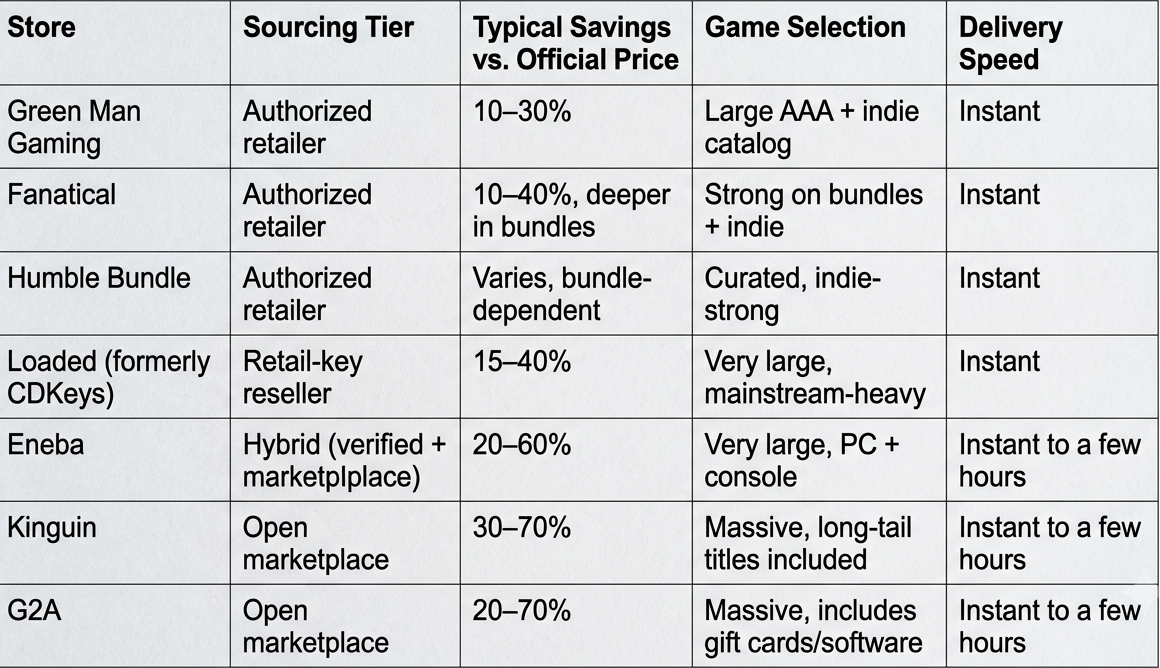
This ranking weighs sourcing tier, real-world refund experience, and total cost, rather than headline price.
Quick Comparison Table
Policy and Support Comparison
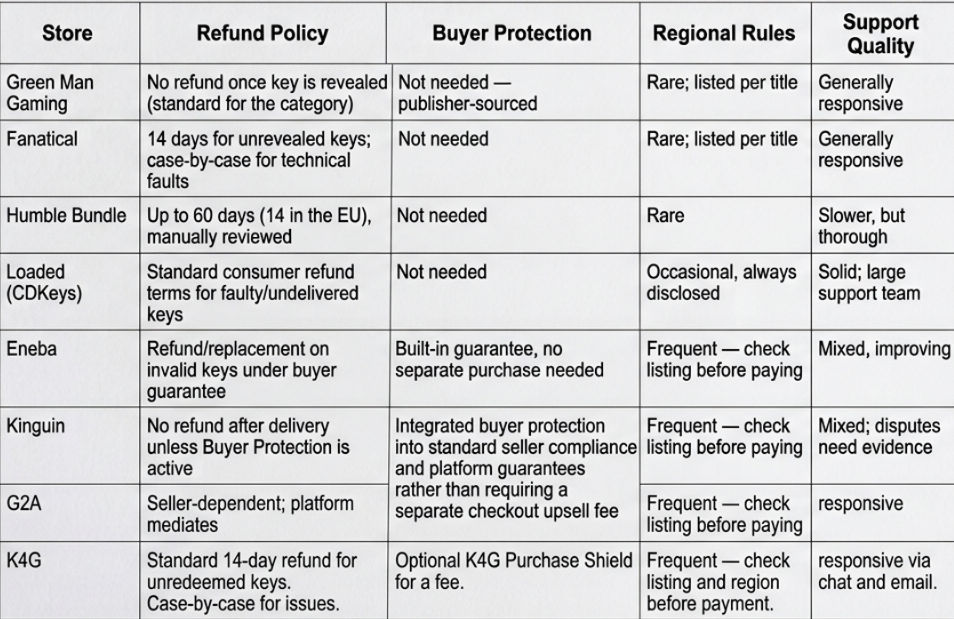
Note: G2A Shield was discontinued several years ago, and G2A Plus is an active paid membership program. Read our guide on Is G2A Safe in 2026? Full Review to get the real insights.
Ideal Use Case Per Store
Green Man Gaming: This is best if you want zero revocation risk and still save on release-day AAA titles, especially when stacking coupon codes.
Fanatical: It’s best for bundles and building a back-catalog of indie games cheaply.
Humble Bundle: This is best if part of your buying decision is where the money goes; the charity-split model is unmatched.
Loaded (CDKeys): It is the best all-around pick for mainstream, big-name releases at a meaningful discount with low sourcing risk.
Eneba: If you want marketplace-level prices with a built-in guarantee doing some of the vetting for you.
Kinguin: It’s best for hard-to-find or long-tail titles. Kinguin retired its separate paid "Buyer Protection" checkout add-on; standard platform policies and automated risk management now apply to purchases directly.
G2A: It provides the absolute lowest price on common titles, for buyers willing to actively vet seller ratings and accept the highest variance in outcomes.
Common Risks: Revoked Keys, Fraudulent Sellers, Region Locks, and Hidden Fees
Buying a CD key carries a handful of specific, well-documented risks, none of them guaranteed to happen, but all worth planning around. Beware of these common risks:
Revoked keys. This happens when a key's origin is later found to involve stolen payment methods or fraud; the publisher can deactivate it retroactively, even after you've played the game. Marketplace tiers carry this risk; authorized retailers essentially don't.
Fraudulent or low-rated sellers. On open marketplaces, individual sellers vary enormously in reliability. A seller with few sales and no review history is a different risk than one with tens of thousands of completed orders.
Region locks. Some keys are tied to activation in a specific country or continent and will fail, or the platform's client will block it outside that region. This is disclosed on the listing, not hidden, but it's easy to miss if you're moving fast.
Hidden fees. The price at the top of the listing isn't always the price at checkout. Platform fees, payment processing surcharges, and optional "protection" add-ons can shift the final number by a noticeable margin, which is exactly why total cost matters more than sticker price, covered next.
Buying from a marketplace doesn’t mean it provides corrupted keys, but it has higher risk than using an authorized retailer. If you’re worried about CD keys not working, then buying cheaper CD keys isn’t the best deal.
The True Cost of a "Cheap" Key
The listed price of a CD key is not the full cost of the purchase; the true cost also includes any protection fee you add, and the time you'd lose resolving a dispute if the key fails. A $10 marketplace key with a $2 protection add-on and no issues costs $12. The same $10 key without protection, if it turns out to be dead, can cost you the original $10 plus days of support back-and-forth with no guaranteed outcome.
This is the calculation most price-comparison sites skip entirely, because it can't be reduced to a single number on a listing page. A practical way to think about it:
Authorized retailer key: listed price equal true cost, in almost all cases. No protection fee needed because there's nothing to protect against.
Retail-reseller key: listed price equal true cost in the large majority of cases, with region restriction as the main variable to check.
Marketplace key with protection: listed price plus protection fee equal realistic expected cost, and this is the number you should compare against the authorized retailer's price, not the marketplace's bare listing price.
Marketplace key without protection: listed price is a best-case number; the realistic expected cost includes a probability-weighted risk of losing the full amount, which is impossible to quantify precisely but is never zero.
Once you compare true cost rather than listed price, the gap between a marketplace deal and an authorized retailer often reduces. Sometimes an "expensive" option is the better value.
How to Buy a CD Key in A Safe Way
Identify the Sourcing Tier Before You Compare Price: Knowing whether you're looking at an authorized retailer, a retail reseller, or an open marketplace listing, it changes every other decision below.
Check the Region Restriction: Check the region restriction on the Listing, not the store's homepage marketing, since region rules are set per title and per seller.
Seller Review and Rating: Read the seller's rating and review count, not just the store's overall rating. When buying on a marketplace, the seller is the actual counterparty.
Add Buyer Protection: Include buyer protection on marketplace purchases, where it's optional; the fee is small relative to the risk it offsets.
Redeem the Key: After purchasing, redeem the key immediately. Most stores' dispute windows are more favorable the sooner an issue is reported.
Use a Renowned Payment Method: Pay by card or PayPal rather than store credit or crypto if possible, since these methods generally create an additional dispute path outside the store itself.
Proof of Purchase: Take a screenshot of the listing and your order confirmation at the time of purchase. If a dispute happens later, this is the evidence support teams ask for first.
Is There Something Better Than CD Keys?
For most PC gamers, the realistic alternative to a one-off CD key purchase is a subscription service like Xbox Game Pass, EA Play, or Ubisoft+, which trades ownership for a flat monthly fee covering many titles at once. It's "better" specifically for high-volume players who churn through games quickly; it's worse for anyone who wants permanent ownership of a smaller number of titles at the lowest possible one-time cost.
Buying direct from the platform (Steam, GOG, Epic) is the other alternative, and it removes sourcing risk entirely. The trade-off is paying full retail price with no regional arbitrage discount.
What Is the Best PC Game Store in 2026?
There's no single best store; the right answer depends on whether you're optimizing for lowest price, zero risk, or best support, and different stores win each category. For most buyers, an authorized retailer like Green Man Gaming or Fanatical is the best default; go to a retail reseller like Loaded for mainstream titles, and reserve open marketplaces for hard-to-find games where you're willing to pay for buyer protection.
By need:
Lowest price overall: G2A or Kinguin, provided you factor in a protection add-on and vet the seller.
Safest option, no exceptions: Green Man Gaming, Fanatical, or Humble Bundle, all authorized, all effectively zero revocation risk.
Best customer support: Loaded (CDKeys) and Humble Bundle both have a reputation for thorough, if not always fast, resolution.
Best for AAA day-one releases: Green Man Gaming, thanks to coupon stacking on top of already-discounted launch pricing.
Best for indie games: Fanatical and Humble Bundle, both built around curated indie bundles.
Best for subscriptions/back-catalog value: Humble Choice or Fanatical's bundle rotation.
Best for global buyers dealing with region locks: Eneba, since region restrictions are flagged clearly per listing and its buyer guarantee is built in rather than optional.
FAQ
Q1: Are cheap CD keys legal to buy?
Ans: Buying a legitimately licensed key from another region is generally treated as a private resale, similar to reselling a physical good, and is not itself illegal in most jurisdictions. The narrower risk is a key later found to be tied to fraud, which is a legitimacy and revocation issue rather than a legal one for the buyer. For a full breakdown of the legal landscape, see this cluster's dedicated legality guide rather than duplicating it here.
Q2: Why do prices for the same game vary so much between stores?
Ans: Prices vary because of the sourcing tier: authorized retailers price close to the publisher's own discount schedule, retail resellers pass on savings from bulk or regional purchasing, and open marketplaces let individual sellers set prices based on whatever region or channel they sourced the key from. The lowest price is usually a marketplace listing precisely because it carries the least verification.
Q3: What should I do if my CD key doesn't work?
Ans: Contact the store or seller immediately with your order confirmation and a screenshot of the error, since most refund and protection windows favor prompt reporting. If you bought buyer protection, file the claim through that program first; it typically has a faster, more defined resolution path than a general support ticket.
Q4: Are region-locked keys a scam?
Ans: No, region locking is a standard, disclosed licensing restriction, not a form of fraud, and it's set by the publisher rather than the seller trying to deceive you. The risk isn't the restriction itself; it's missing the disclosure on the listing and buying a key that won't activate where you live.
Q5: Is it worth paying extra for buyer protection on marketplace purchases?
Ans: Generally yes, if you're buying from a reputable open marketplace, since the protection fee is small relative to the amount you'd lose if the key turns out to be invalid or revoked. For authorized retailer purchases, it isn't necessary, since the sourcing risk it's designed to cover essentially doesn't exist there.
Don't overpay for your games or take unnecessary risks. Stick to our verified merchants and get the best savings on your wishlist right now.